
Achilles
The demigod, the plant, and the tendon.

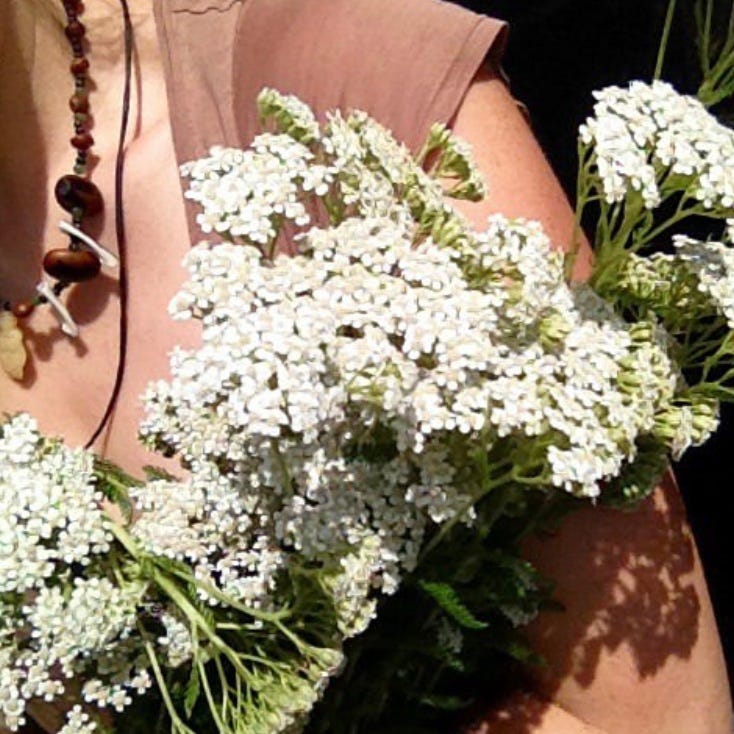
Yarrow, or Achillea millefolium, is an excellent wound herb. Topically, it’s used in salves, washes, and poultices as a disinfectant and to stop bleeding. It shares it’s name with the Achilles tendon. That’s because of Thetis’ part in Achilles’ story in Greek mythology. Achilles’ father was a mortal king, and his mother, Thetis, was a Sea Nymph. It was foretold that Achilles would grow up to be a great warrior who would be remembered and celebrated as a hero by his people but it was also foretold that he would die in battle at a young age. Thetis, seeking to protect her beloved son from this fate, cast a protection spell during which she held him upside down by his ankles and dipped him into the River Styx. The part of the story that I had not heard until I heard my herbalist tell it, was that there had been Yarrow growing all along the banks of the river, and it had been its power that had helped Achilles become invincible everywhere the water touched him, everywhere except his Achilles tendons, where his mother had been holding onto him. There is even a species of Yarrow called Achilles militaris that has been praised since antiquity for its effectiveness at staunching blood on the battlefield.
Now the point that I’m trying to get to in telling this story, is that stories are powerful. Some parts may be fictional, but all stories hold some truth. They also hold our curiosity, engage our imagination, and make the truths they hold easier to remember and pass down. They keep our lives interesting, even captivating. But there are some old white dudes sitting around a conference table somewhere, trying to take the mythology out of scientific names. We learned in our Palpatory Anatomy class at Jung Tao that they’d rather call the Achilles tendon the Calcaneal tendon, after the Calcaneus, the scientific name for the heel bone, because that’d be more scientific. I was outraged. In my opinion, it’s a disservice to try to take all of the intrigue and culture out of the medical sciences and try to keep everything as dry and boring as possible, necessitating a lot of rote memorization, which is not my favorite way to learn.
But tonight, I believe I have uncovered a failure on the part of those dudes, whoever they are, sitting around that conference table, wherever it is. When you look into the origin of the term Calcaneus to refer to the heel bone, the internet consistently says, we don’t know, probably Greek or Latin. And when you read through Achilles’ story, you find that Calchas is another character in it. They were the oracle or soothsayer who foretold both that Achilles would die at the battle at Troy and also that Troy would not fall without Achilles. This lead to both the king forcing his son into hiding and the Greeks searching him out. He is given a chance to choose his fate and rides out with his men to meet it, choosing to die a hero rather die alone in obscurity.
Don’t get me wrong. I’m not a fan of war or colonialism; I’m just a fan of keeping the richness that makes life worth living. And to those dudes around that conference table, all I have to say is, ha ha, you loose!